Three labs your doctor probably isn’t ordering.
And why the panel that came back fine is not the same as a body that is.
I had a call last week with a woman who had been to four doctors in two years. Every panel: fine. Every visit: your labs look great. She sat in her car after the last appointment and cried, because she could not feel her own legs the right way and her chart said she was healthy.
I have heard a version of that story so many times I have stopped being surprised. The grief is the same. The chart is the same. The body is the same.
The problem is not always the doctor. It is the size of the screen they were handed.
What a standard panel actually does
A standard wellness panel is built to catch disease. Anemia. Diabetes. Kidney damage already in progress. A thyroid in full failure. It is a smoke alarm, and it is excellent at telling you there is a fire. It is not designed to tell you there is a candle.
Most of the women I work with are in the candle phase. The system is not on fire yet. It is just sending up the kind of smoke an unhurried doctor with twelve patients before lunch will not see. So when your panel comes back fine, I believe your doctor. I also believe your body. Both can be true at once. Here are three labs I wish more women knew to ask for. None are exotic. They are just the right resolution.
1. A full thyroid panel, with antibodies
What you usually get: TSH. Maybe a Free T4 if you are lucky. What you want: TSH, Free T3, Free T4, Reverse T3, and both thyroid antibodies, TPO and thyroglobulin. All of it, in one draw.
TSH is the pituitary's vote on whether your thyroid is working. It is one voice in a much longer conversation. Your cells do not run on TSH, and they do not even run on T4. They run on T3, the active hormone that actually walks into a cell and makes you feel warm, awake, regular, and sharp. A woman can have a perfectly normal TSH and a Free T3 in the basement, and she will be cold, exhausted, constipated, and losing hair at the temple while her chart says her thyroid is fine.
The antibodies matter most of all. Hashimoto's, the most common cause of low thyroid in women, is autoimmune, and the antibodies almost always show up first, often years before the gland visibly fails. If no one is checking them, no one catches it early.
2. Ferritin, not just hemoglobin
What you usually get: hemoglobin. What you want: ferritin, with its own number.
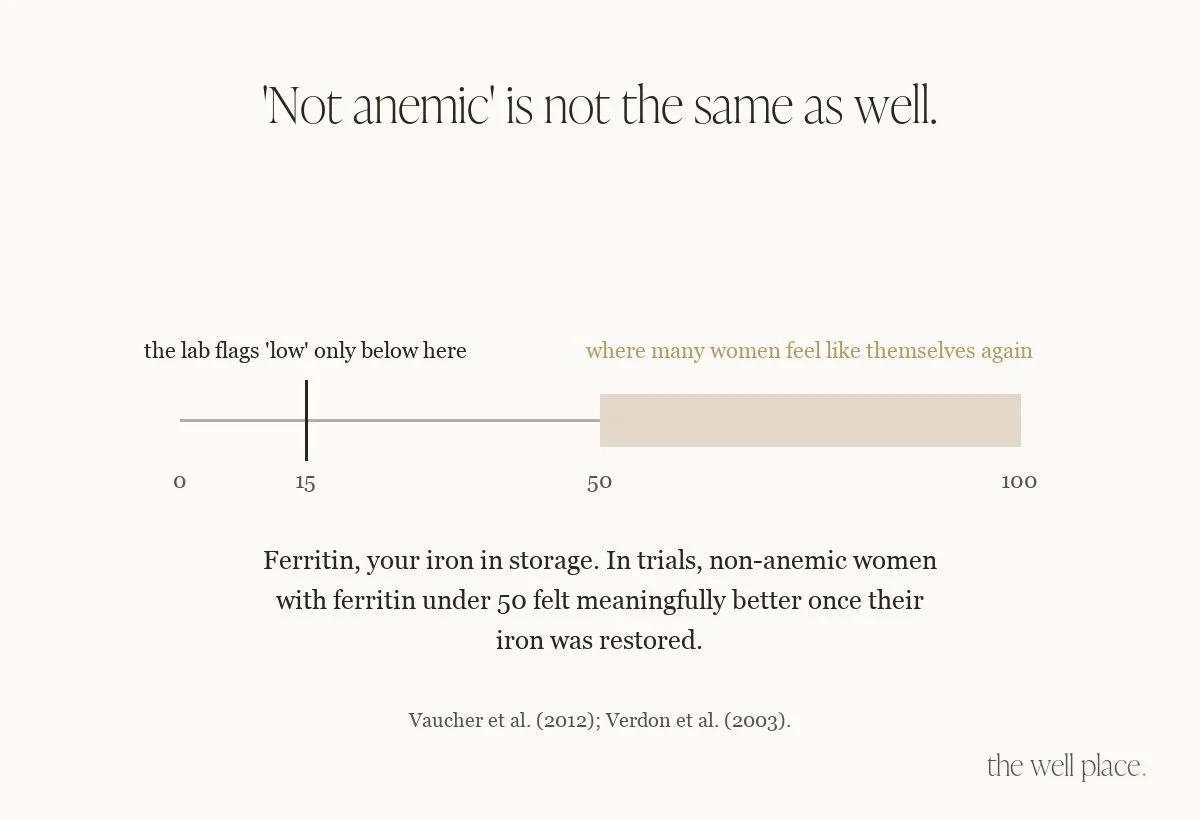
Hemoglobin tells you whether you are anemic. Ferritin tells you whether you have any iron in storage. Two different questions. Women bleed every month for thirty years, lose blood at every delivery, and pour iron into breast milk, and then get told their hemoglobin is fine and sent home while their ferritin sits at 12 and they cannot climb the stairs without losing their breath.
The reference range is wide, and most labs flag anything above 10 or 15 as normal. But the fatigue research points higher than that floor. In controlled trials, non-anemic women with ferritin under 50 felt meaningfully better once their iron was replenished. There is a real gap between not anemic and actually well. Ask for the number, not "in range." The number.
3. Minerals, at the tissue level
What you usually get in this category: nothing, ever.
Minerals are the spark plugs of the cell. Every enzyme, every unit of ATP, every hormone conversion needs them. And a standard serum mineral can read perfectly normal while your tissue is empty, because your blood will quietly steal from your bones, your muscles, and your nerves to keep that serum number stable. A normal serum magnesium can sit right next to a clenched jaw all night, a twitching eye, and a bowel that will not move on its own.
The honest options here are imperfect, and I will say so. A urinary mineral panel, or a hair tissue mineral analysis, tries to read the tissue level rather than the blood, and while these tools are debated and no single number is gospel, the principle is sound: serum is not storage. If you have chased twitches, cramps, brain fog, and bad sleep with no answers, this is a layer worth looking at.
What to do with this
You do not need all three this month. Pick one, the one closest to the symptom you have carried the longest. Cold, tired, thinning hair: the thyroid panel. Breathless, dizzy standing up, postpartum or perimenopausal: ferritin. Twitches, cramps, brain fog, restless legs, jaw tension: the minerals. Bring the results to your provider. If they brush you off, find a functional-medicine practitioner who will actually read them.
Why I care about this
Because there is a woman reading this with a folder of fine labs, being told it is in her head, and it is not in her head.
There is a line in Proverbs that says to know well the face of your flocks. It is shepherd language, the intimate kind of knowing where you can spot the limp in the back lamb from twenty yards. Your body is the flock you were given. You are allowed to know it that well, and to ask the questions that get you to that resolution.
The data is on your side. Go get it.
If you want help reading what your panels are actually saying, the Vessel Snapshot reads sixteen systems at the bioenergetic level and starts at $97. Meet me in the Reading Room.
References
Vanderpump MPJ, Tunbridge WMG, French JM, et al. (1995). The incidence of thyroid disorders in the community: a twenty-year follow-up of the Whickham Survey. Clinical Endocrinology, 43(1), 55–68. https://doi.org/10.1111/j.1365-2265.1995.tb01894.x
Vaucher P, Druais PL, Waldvogel S, Favrat B. (2012). Effect of iron supplementation on fatigue in nonanemic menstruating women with low ferritin: a randomized controlled trial. CMAJ, 184(11), 1247–1254. https://doi.org/10.1503/cmaj.110950
Verdon F, Burnand B, Stubi CLF, et al. (2003). Iron supplementation for unexplained fatigue in non-anaemic women: double blind randomised placebo controlled trial. BMJ, 326(7399), 1124. https://doi.org/10.1136/bmj.326.7399.1124