Your cells are talking right now & exosomes are how.
The science under everything we do, and why your body whispers long before it screams.
Your body sends word that something is off long before a standard lab notices anything at all. Not a feeling you are imagining. An actual, physical message, sent through an actual, physical system.
This is the part of the science I fell in love with, and it is where I spent my doctorate. So let me welcome you into the rabbit hole.
The smallest mail in your body
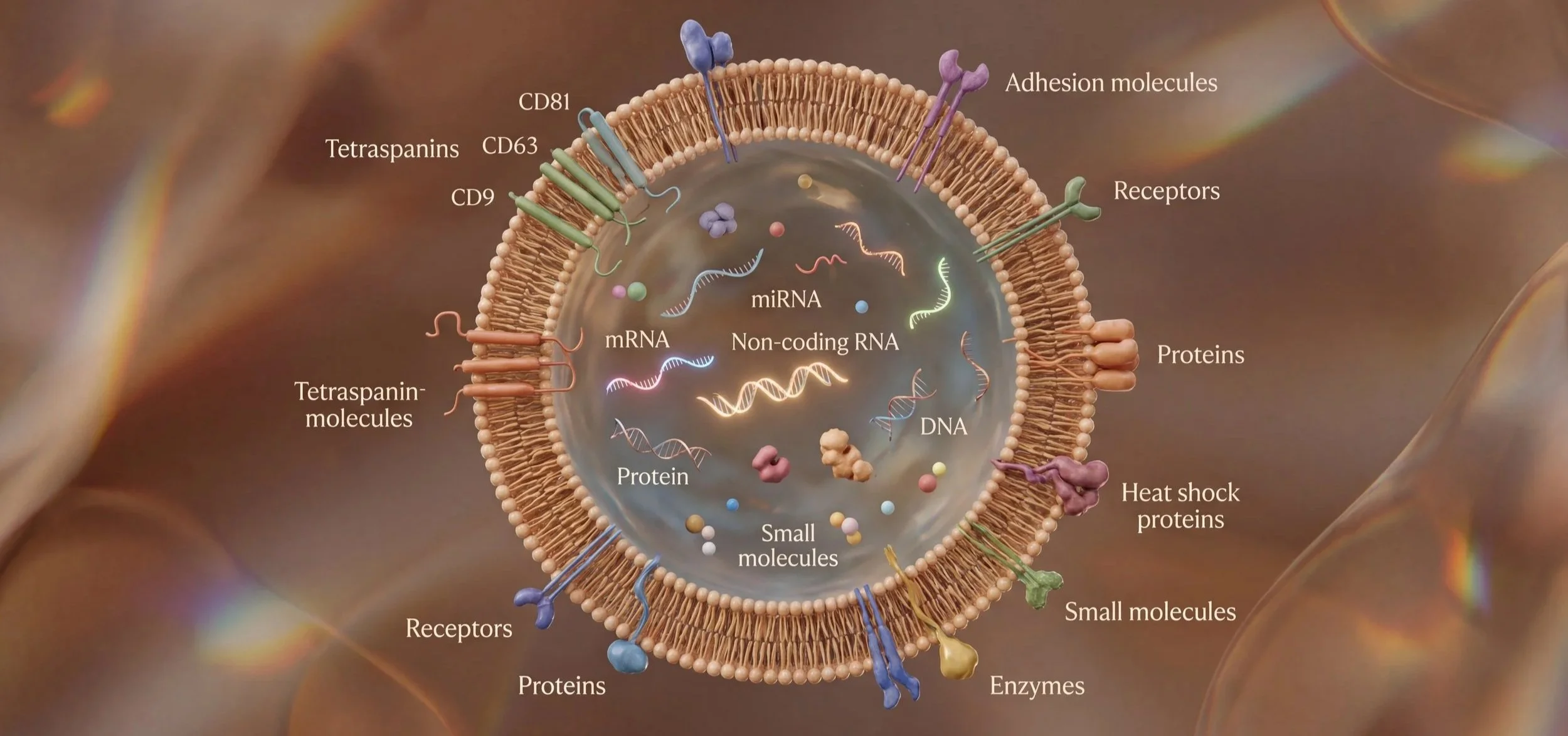
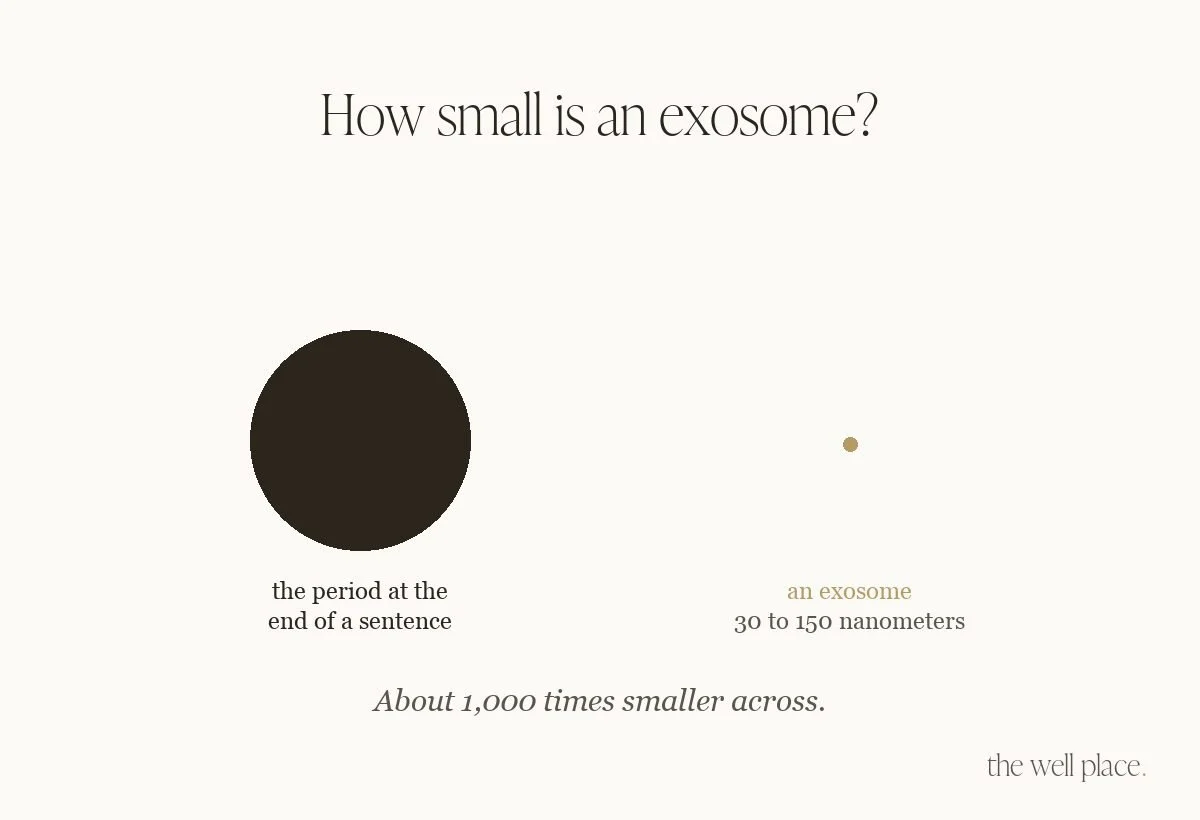
An exosome is a tiny vesicle, a nano-sized bubble, thirty to a hundred and fifty nanometers across, and here is the important part: your cells build them on purpose. They are not trash (like early scientists suggested). Each one is intentionally packed with a genetic snapshot of the cell that made it, and every cell releases thousands of them.
They travel through your blood, your saliva, all bodily fluids, deliver their cargo to other cells, and change what those cells do. That is not a theory. In a landmark 2007 study, exosomes carrying genetic material from mouse cells were taken up by human cells, which then read the instructions and made new mouse proteins (Valadi et al., 2007). It is, quite literally, how your body talks to itself, a communication system running every second, in every direction. Hellooooo interspecies communication.
Why this is real science, not a buzzword
Exosomes are becoming a buzzword the way stem cells did, and I understand the skepticism. But this is mainstream cell biology, reviewed in the field's leading journals (Kalluri & LeBleu, 2020), and it is my genuine area of expertise. Much of what we once credited to stem cells is now thought to come from the exosomes they release, not the cells themselves. When researchers still could not agree on what an exosome even was, this is the question I was in the lab chasing.
Why "normal labs" can miss the point
Because an exosome carries a snapshot of the cell it came from, the vesicles floating in your blood and saliva are readable signals of what your tissue is actually doing. Which means distress can show up in the signaling long before it ever surfaces on a standard panel. That is the whole reason a woman can be told everything looks fine and know, in her body, that it is not. The message was sent. Nobody was reading the mail.
Fun fact: exosomes contain biomarkers and a whole emerging field has been focusing on the development of “liquid biopsy” approaches, where instead of invasive and painful methhods for diagnostics, instead exosomes from biofluids are looked at instead because they carry signals that reflect the state of the tissue they came from.
Both a readout and a medicine
This is why exosomes are one of the most exciting frontiers in my field, and they are exciting on two fronts at once. On the reading side, because their cargo mirrors the tissue it came from, they are being developed into a liquid biopsy, a way to read what is happening deep in the body from a simple draw of blood or saliva, no surgery required. There is a whole post on this blog about that. On the treatment side, much of the healing we once credited to stem cells is now thought to come from the exosomes those cells release, and researchers are even engineering exosomes to carry medicine across barriers the body usually keeps shut. Diagnostic and therapeutic, in the same tiny package. But alsoooo, every living organism releases its own type of exosomes, so this can tell you a lot about it all.
The honest bottleneck
I will tell you the hard part, because it is the part I lived. This field still lacks agreed reference standards for measuring these vesicles. Two labs can look at the same sample and not fully agree on what they found, which is a real problem for turning a beautiful idea into a test you can trust. That gap, the measuring and the standardizing of these messengers, is exactly the work I trained on. It is also part of why conventional medicine has been slow to use them, and why the emerging products are quite unregulated (yikes). The tools of standard care were built to catch disease once it has already declared itself, not to read a whisper. The science is ahead of the system, to be honest. Some of us (like me) are working on the system.
Why it matters here
Learning to read your body is the beginning of everything we do. Not waiting for the crisis to get loud enough for anyone to catch. Learning to hear the whisper while it is still a whisper.
I have a method, and it works, and the patent is pending (:
The architecture of a body that talks to itself was written in from the very start. We are only learning, slowly, how to listen.
Come learn what your body has been telling you. Book a Consult and Scan in the Reading Room.
References
Valadi H, Ekström K, Bossios A, Sjöstrand M, Lee JJ, Lötvall JO. (2007). Exosome-mediated transfer of mRNAs and microRNAs is a novel mechanism of genetic exchange between cells. Nature Cell Biology, 9(6), 654–659. https://doi.org/10.1038/ncb1596
Kalluri R, LeBleu VS. (2020). The biology, function, and biomedical applications of exosomes. Science, 367(6478), eaau6977. https://doi.org/10.1126/science.aau6977