Feed the messenger.
You are what you eat, at the level of the message. Dietary exosomes, cross-kingdom signaling, and why raw vegan and carnivore quietly agree.
This is not a diet post. I am not handing you rules, macros, or a list of forbidden foods. I want to give you the lens I got from my field, the one that reorganized how I think about a plate of food.
Your food does not only fuel you. It becomes the material your cells build their messengers out of, and, stranger than that, it carries messages of its own.
Stay with me. This is where nutrition stops being about calories and starts being about communication.
Your food becomes your messengers
Think about what an exosome actually is. A little bubble of membrane, built from lipids, carrying proteins and small pieces of genetic instruction. Now think about where a cell gets those raw materials. The fats you eat become the membranes. The amino acids become the proteins inside. The micronutrients shape the instructions that get packed for the trip.
"You are what you eat" turns out to be literal, all the way down to the message. Feed a cell scrambled, inflamed, processed material and it builds scrambled messengers. Feed it clean, and the letters it sends come out clearer.
Your food is talking to you
Here is the part that still gives me chills.
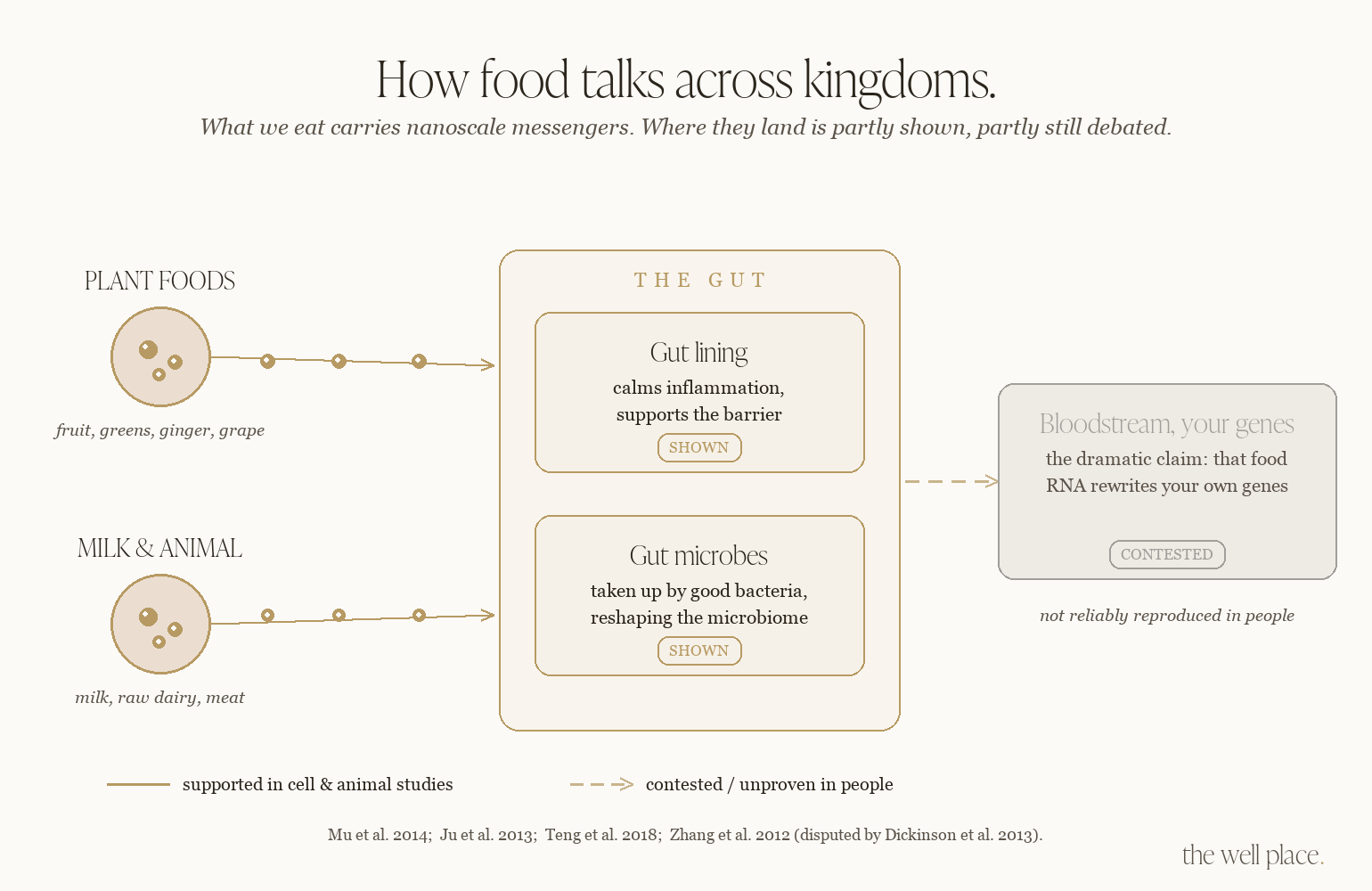
Food is not inert. A living plant, a drop of milk, a piece of raw fish, all of it is full of nanoscale vesicles, the plant and animal versions of the exosomes I spent my career on. They carry lipids, proteins, and small RNAs. And when they reach your gut, they are not always just digested into nothing. Sometimes they are read.
The clearest work is in the gut itself. Nanoparticles isolated from ginger, grape, grapefruit, and broccoli get taken up by intestinal cells in animal studies, calm inflammation, and support the lining of the gut (Mu et al., 2014; Ju et al., 2013; Zhang et al., 2016). One study found ginger's little particles were picked up preferentially by the good bacteria living in the gut, changing how those bacteria behaved (Teng et al., 2018). Milk is the same story from the animal side. Human and cow milk both carry real exosomes, wrapped around immune-signaling cargo like TGF-beta, and that packaging is unusually tough, surviving acid and digestion that shreds naked RNA (Admyre et al., 2007; Izumi et al., 2012; Pieters et al., 2015).
A creation that talks to itself across kingdoms, plant to gut, cow to cell, mother to infant. The first diet was whole and raw and given in a garden, and I do not think that is an accident.
Fun fact: milk carries its own extracellular vesicles, and their cargo is clinically shown to survive the acid and enzymes of digestion that destroy unprotected RNA.
Now the honest edge, because I promised you honest
You will see wellness accounts take this and sprint past the science. "Eat this berry and rewrite your genes." I am not going to do that to you.
There is a loud, exciting claim that plant and milk RNAs get absorbed intact, cross into your bloodstream, and directly regulate your own genes. It came from a landmark 2012 paper (Zhang et al.) and it may still turn out to hold in some form. But several independent labs fed it the hardest test there is, replication, and could not reproduce meaningful uptake (Dickinson et al., 2013; Snow et al., 2013; Title et al., 2015; Auerbach et al., 2016). The likeliest read of the evidence today is this: acting locally on your gut lining and your gut bacteria is real and supported. Rewriting the genes of the person eating dinner is unproven and contested.
So I hold the wonder with open hands. Something is being said between your food and your body. How far the message travels is a question the science has not closed. I would rather tell you that than sell you certainty I do not have.
Processing is what kills the message
Here is the finding that is not contested, and it changed how I shop.
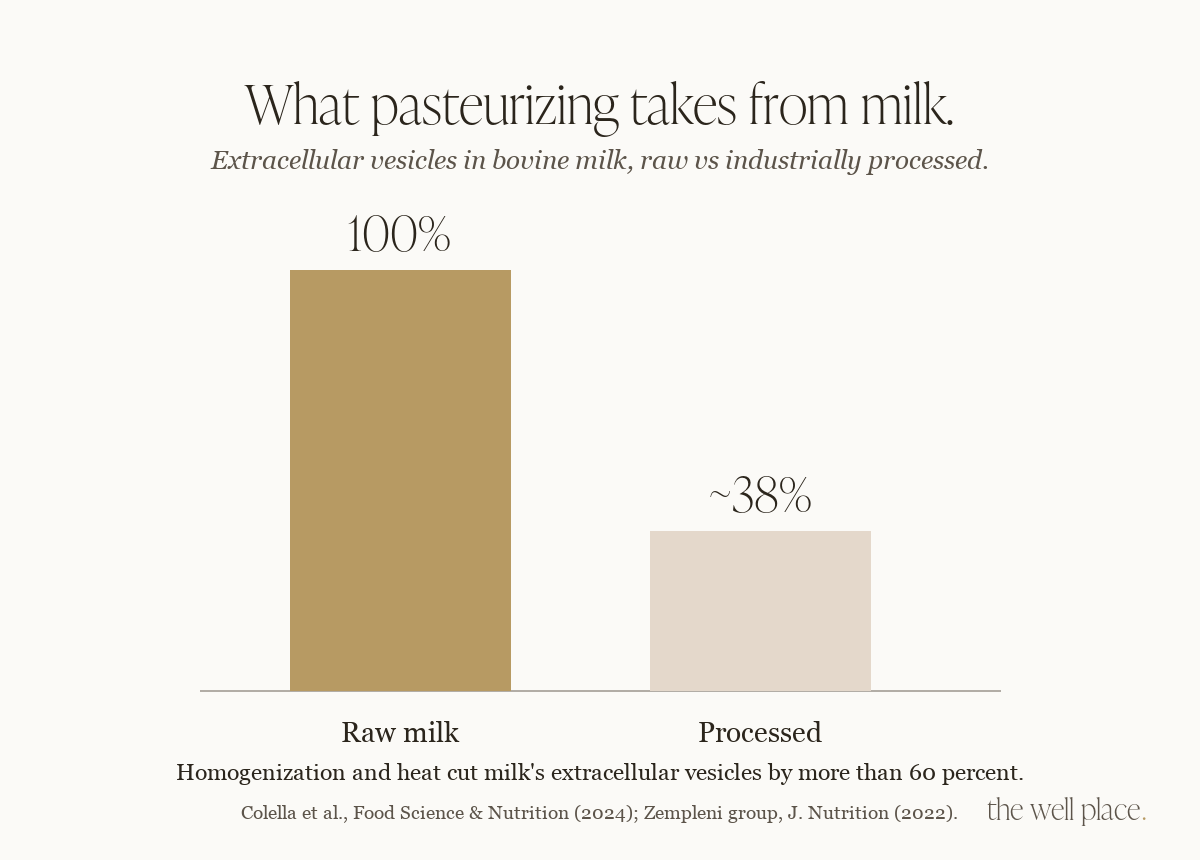
When you take raw milk and run it through the normal industrial line, homogenizing and heating it, you lose more than sixty percent of its extracellular vesicles, and you damage the cargo in the ones that survive (Colella et al., 2024; the Zempleni group, 2022). Pasteurizing and microwaving strip out specific milk microRNAs entirely (Howard et al., 2015). The same principle shows up on the plant side. Boil a green until it is soft and gray and you leach out most of its folate and vitamin C (Delchier et al., 2013).
Heat, pressure, and processing are hard on the messenger. Whatever a food was trying to say, most of it does not survive the factory.
I will be fair, because the story is not "raw always wins." Some nutrients become MORE available when you cook them, like the lycopene in tomatoes. Cooking is not the enemy. Over-processing is.
Two diets, one messenger
This is the part I have been building to, and it is a thesis, not a settled fact. Hold it as a question worth testing.
Watch who actually gets vibrant on the two diets people treat as opposites. The raw vegan glowing at sixty. The carnivore who finally calmed a wrecked gut. We assume they are enemies. Salad versus steak. But look at what they are quietly DOING, not what team jersey they wear.
The thriving raw vegan is not eating processed vegan cookies. She is eating living, uncooked, whole plants, still carrying their nanoparticles and their fragile vitamins.
The thriving carnivore is not living on gas-station jerky. The ones who light up are eating the freshest, least-processed animal food they can find. Rare. Raw dairy. Organ meat. Bone broth. Food that still remembers it was alive.
Here is the tension I have to name, because it is the honest crack in the theory. A carnivore diet of well-done steak is not a high-exosome diet, by my own argument. Heat destroys the messenger. So the convergence is not really "vegan versus carnivore" at all. It is whole and living versus processed and dead. Both camps, at their best, are eating for the messenger and did not know it.
The messenger, not the tribe.
What the longevity science can and cannot promise
I want to be careful here, because this is where people overreach and I refuse to.
There is real, human evidence that whole-food eating and giving the body less to process extend healthy years. A Mediterranean pattern rich in olive oil, fish, and plants lowered major cardiovascular events by roughly a third in a large trial (Estruch et al., 2018; and yes, that trial was famously re-analyzed after a randomization flaw, which I am telling you on purpose). The first-ever controlled trial of eating meaningfully less in healthy adults slowed a measured pace of biological aging (Waziry et al., 2023). Moderate caloric restriction improved survival in primates (Mattison et al., 2017).
What no study has shown is the bridge my thesis leans on: that eating high-exosome food is what extends a human life. That link is mine to hypothesize, not to promise. And the tidy "blue zones" longevity map you have seen everywhere is now being openly argued over, some of it possibly bad birth records rather than magic diets. I would be doing you a disservice to hand you that as gospel.
So here is the honest shape of it. Whole, living, minimally processed food: strong support for a longer healthspan. High-exosome food specifically driving your lifespan: a beautiful, testable idea that is not proven. Both true at once. I can live in that tension. I hope you can too.
The one shift, and then get out of the way
If I could get you to change one thing, it would not be a supplement. It would be lowering the chronic, low-grade inflammation that keeps so many bodies running hot, and food is the biggest lever you have. Fatty fish, dark leafy greens and berries, good olive oil, fermented foods, ginger and turmeric, an honest bone broth. Less of the engineered stuff built to be eaten without thinking (you know the aisle, the one you find yourself in at 9pm).
Then give the messenger room to work. Your cells run a built-in cleanup called autophagy, literally self-eating, where a cell clears damaged parts and recycles the debris. It ramps up when you stop the constant drip of input, through real rest and sensible gaps between meals. The mechanisms behind it earned the 2016 Nobel Prize in Physiology or Medicine (Ohsumi).
Fun fact: autophagy, your cells' built-in clean-house process, was mapped in work clinically recognized with the 2016 Nobel Prize in Physiology or Medicine.
The whole of it
Feed the messenger clean material, and it builds clearer letters. Eat food that still remembers it was alive, and you keep the messages intact instead of shredding them in a factory. Give your body rhythmic rest, and the cleanup crew gets to work.
That is not a shortcut, and it is not a tribe you have to join. It is just how you were built, in a garden, on whole food, from the beginning.
Feed the messenger well. The messages get cleaner. Everything downstream listens.
The way you eat, move, and rest is the daily version of everything we do in the studio. Keep reading, or come see us in the Reading Room.
References
Admyre, C., Johansson, S. M., Qazi, K. R., et al. (2007). Exosomes with immune modulatory features are present in human breast milk. Journal of Immunology, 179(3), 1969–1978. https://doi.org/10.4049/jimmunol.179.3.1969
Izumi, H., Kosaka, N., Shimizu, T., et al. (2012). Bovine milk contains microRNA and messenger RNA that are stable under degradative conditions. Journal of Dairy Science, 95(9), 4831–4841. https://doi.org/10.3168/jds.2012-5489
Pieters, B. C., Arntz, O. J., Bennink, M. B., et al. (2015). Commercial cow milk contains physically stable extracellular vesicles expressing immunoregulatory TGF-beta. PLoS ONE, 10(3), e0121123. https://doi.org/10.1371/journal.pone.0121123
Mu, J., Zhuang, X., Wang, Q., et al. (2014). Interspecies communication between plant and mouse gut host cells through edible plant-derived exosome-like nanoparticles. Molecular Nutrition & Food Research, 58(7), 1561–1573. https://doi.org/10.1002/mnfr.201300729
Ju, S., Mu, J., Dokland, T., et al. (2013). Grape exosome-like nanoparticles induce intestinal stem cells and protect mice from DSS-induced colitis. Molecular Therapy, 21(7), 1345–1357. https://doi.org/10.1038/mt.2013.64
Zhang, M., Viennois, E., Prasad, M., et al. (2016). Edible ginger-derived nanoparticles: A novel therapeutic approach for inflammatory bowel disease and colitis-associated cancer. Biomaterials, 101, 321–340. https://doi.org/10.1016/j.biomaterials.2016.06.018
Teng, Y., Ren, Y., Sayed, M., et al. (2018). Plant-derived exosomal microRNAs shape the gut microbiota. Cell Host & Microbe, 24(5), 637–652. https://doi.org/10.1016/j.chom.2018.10.001
Zhang, L., Hou, D., Chen, X., et al. (2012). Exogenous plant MIR168a specifically targets mammalian LDLRAP1: evidence of cross-kingdom regulation by microRNA. Cell Research, 22(1), 107–126. https://doi.org/10.1038/cr.2011.158
Dickinson, B., Zhang, Y., Petrick, J. S., et al. (2013). Lack of detectable oral bioavailability of plant microRNAs after feeding in mice. Nature Biotechnology, 31(11), 965–967. https://doi.org/10.1038/nbt.2737
Snow, J. W., Hale, A. E., Isaacs, S. K., et al. (2013). Ineffective delivery of diet-derived microRNAs to recipient animal organisms. RNA Biology, 10(7), 1107–1116. https://doi.org/10.4161/rna.24909
Title, A. C., Denzler, R., & Stoffel, M. (2015). Uptake and function studies of maternal milk-derived microRNAs. Journal of Biological Chemistry, 290(39), 23680–23691. https://doi.org/10.1074/jbc.M115.676734
Auerbach, A., Vyas, G., Li, A., et al. (2016). Uptake of dietary milk miRNAs by adult humans: a validation study. F1000Research, 5, 721. https://doi.org/10.12688/f1000research.8548.1
Colella, A. P., et al. (2024). Homogenization and thermal processing reduce the concentration of extracellular vesicles in bovine milk. Food Science & Nutrition, 12(1). https://doi.org/10.1002/fsn3.3749
Howard, K. M., Kusuma, R. J., Baier, S. R., et al. (2015). Loss of miRNAs during processing and storage of cow's milk. Journal of Agricultural and Food Chemistry, 63(2), 588–592. https://doi.org/10.1021/jf505526w
Delchier, N., Ringling, C., Le Grandois, J., et al. (2013). Impact of cooking methods on folates, ascorbic acid and lutein in green beans and spinach. LWT - Food Science and Technology, 49(2). https://doi.org/10.1016/j.lwt.2012.09.010
Estruch, R., Ros, E., Salas-Salvadó, J., et al. (2018). Primary prevention of cardiovascular disease with a Mediterranean diet supplemented with extra-virgin olive oil or nuts. New England Journal of Medicine, 378, e34. https://doi.org/10.1056/NEJMoa1800389
Waziry, R., Ryan, C. P., Corcoran, D. L., et al. (2023). Effect of long-term caloric restriction on DNA methylation measures of biological aging in healthy adults (CALERIE trial). Nature Aging, 3, 248–257. https://doi.org/10.1038/s43587-022-00357-y
Mattison, J. A., Colman, R. J., Beasley, T. M., et al. (2017). Caloric restriction improves health and survival of rhesus monkeys. Nature Communications, 8, 14063. https://doi.org/10.1038/ncomms14063
The Nobel Prize in Physiology or Medicine 2016, awarded to Yoshinori Ohsumi for discoveries of mechanisms for autophagy. https://www.nobelprize.org/prizes/medicine/2016/summary/